
VocalNewsMedia Com is an active general-interest publishing website covering a wide mix of subjects rather than one narrow editorial beat. Its current homepage includes business, technology, health, entertainment, education, finance, law, travel, AI, lifestyle, and other categories.
For readers, the main value lies in knowing what type of website it is, how its content is organized, and how much verification a particular article requires.
The site remains active in 2026. Its homepage currently features material dated as recently as September 22, 2026, alongside older articles stretching back several years.
What Is vocalnewsmedia com?
vocalnewsmedia com is the search-style name for VocalNewsMedia.com, a multi-category digital publishing site. It carries informational articles, guides, reviews, educational material, business content, lifestyle pieces, and articles built around specific online topics.
It is better understood as a broad content platform than as a publication dedicated to one specialist field. The live category list currently includes Entertainment with 33 posts, Health with 32, Blog with 20, Business with 17, Technology with 13, and Education with eight, plus numerous smaller sections.
Reader flow:
Search result → Open article → Identify category → Check author and date → Read core information → Inspect supporting evidence → Verify high-impact claims externally → Decide how much weight to give the article
That sequence matters because different posts can serve very different purposes.
Why Is vocalnewsmedia com Important to Evaluate?
A broad publisher can be useful without every page carrying the same editorial weight. Understanding the platform helps readers separate discovery value from authority.
- Wide subject coverage: One domain can expose readers to subjects ranging from AI and business to health, entertainment, law, literature, and travel.
- Accessible entry points: Articles frequently use recognizable headlines and straightforward structures suited to quick browsing.
- Historical depth: Material visible on the domain dates back several years, while new posts continue appearing in 2026.
- Different content purposes: Some pages function as practical guides, while others discuss websites, books, services, business topics, or general-interest subjects.
- Reader judgment matters: A recipe-like lifestyle article and a health, legal, or financial claim should not automatically receive the same level of scrutiny.
The useful question is therefore not simply whether the website exists. The better question is what evidence a particular page provides for the claim being made.
Quick Reference Matrix
| Core Element | Action / What It Involves | Primary Goal / Output |
|---|---|---|
| Website identity | Confirm the exact .com domain | Avoid look-alike sites |
| Content scope | Note the article’s subject area | Establish context |
| Publication date | Check when the page appeared | Judge freshness |
| Author attribution | Inspect the displayed byline | Understand accountability |
| Evidence quality | Review references and supporting material | Measure reliability |
| Page purpose | Distinguish guide, review, commentary, or advice | Interpret intent |
| External confirmation | Compare important claims with primary sources | Reduce factual risk |
How to Evaluate and Use the Platform Step by Step
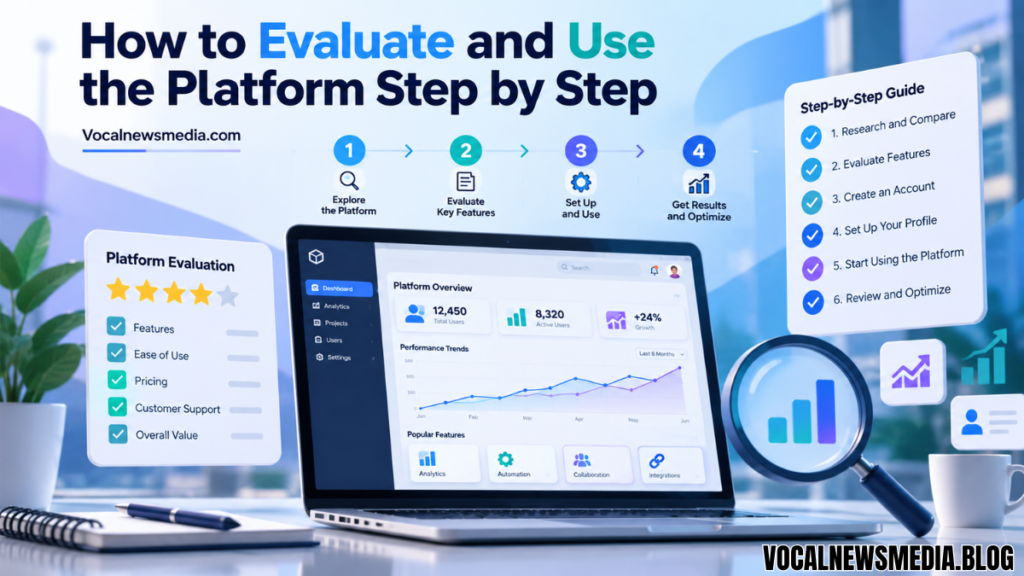
A domain-level judgment is rarely enough. Article-level checking produces a more useful answer.
Step 1: Confirm That You Are on the Correct Domain
Similar-looking web addresses can easily create confusion.
The active site reviewed for this guide is VocalNewsMedia com. Search results also contain differently spelled domains, so look at the browser address rather than relying entirely on a search-result title.
- Check the spelling.
- Confirm the
.comending. - Ignore extra words inserted into the domain.
- Recheck the URL before entering any information.
This takes seconds and prevents research from being based on the wrong publisher.
Step 2: Identify the Page’s Actual Editorial Category
Do not judge an article from the website name alone.
The current site spans more than 20 visible category labels, including AI, Automobile, Crypto, Education, Finance, Game, Health, Home, Law, News, Real Estate, Technology, Trading, Travel, and World.
Ask three questions:
- What problem is the article answering?
- Does its category fit that problem?
- Does the writer demonstrate topic-specific knowledge?
That distinction becomes especially relevant on general-interest publishers, where editorial depth can differ by subject.
Step 3: Inspect the Byline and Publication History
The live homepage shows named contributors including Shivi Hyde and Devin Haney across multiple articles. Recent entries also display publication dates beside the authors.
Use that information as the start of your evaluation, not the end.
| Check | What to Look For |
|---|---|
| Author | Named person rather than missing attribution |
| Date | Clear original publishing date |
| Update history | Separate updated date when applicable |
| Author archive | Previous work on related subjects |
| Expertise signals | Relevant professional background where needed |
A name alone does not prove expertise. Context does.
Step 4: Separate Low-Risk Information From High-Stakes Claims
Not every article deserves the same verification workload.
A general entertainment article may require little more than checking names and dates. Medical, financial, legal, cybersecurity, investment, or safety guidance demands far stronger sourcing.
Use this simple threshold:
- Could acting on the information cost money?
- Could it affect health or safety?
- Could it create legal consequences?
- Could the fact have changed recently?
One “yes” is enough to justify checking a stronger independent source.
Step 5: Examine the Evidence Behind the Article
Strong-looking formatting can make weak information appear authoritative. Ignore presentation for a moment and inspect where the facts came from.
Look for:
- Direct government records
- Official company documentation
- Academic research
- Court or regulatory documents
- First-party technical documentation
- Clearly attributable interviews
- Specific datasets
Generic statements without identifiable support deserve less confidence than claims readers can independently trace.
Step 6: Check Whether the Article Is Primarily Informational or Promotional
Some website-focused articles on the domain discuss external brands or other online platforms. The homepage, for example, currently surfaces pieces centered on Wallpostmedia, HerBlogs, HaruWatch, TheLifestyleEdge.com, SoSoActive, and other named properties.
That does not automatically make an article inaccurate.
It does mean readers should distinguish between independent analysis and brand-oriented exposure. Inspect outbound links, claims of superiority, commercial language, and whether disadvantages receive meaningful coverage.
Industry and Use-Case Specific Scenarios
Different readers can get very different value from the same platform.
vocalnewsmedia com for Casual Readers
Casual visitors may use the site as a discovery layer.
Someone interested in entertainment, books, general technology, lifestyle topics, or everyday business subjects can move between categories without needing specialist knowledge. The broad catalog favors browsing over deep specialization.
For that audience, relevance and readability may matter more than academic sourcing.
For Students
Students can use general web articles to identify terminology, questions, names, and search directions.
The page itself should not automatically become the final academic reference. A stronger workflow is to extract the useful concept, then locate textbooks, journals, institutional websites, or original documents.
That approach turns casual reading into structured research.
For Business Professionals
Business readers should focus on specific actionable claims.
Pricing figures, market statistics, regulations, software specifications, tax information, and financial numbers can age quickly. Cross-reference such details with the organization responsible for producing the original data.
General explainers are most useful here as orientation.
For SEO and Content Professionals
The site provides an interesting example of multi-topic publishing architecture.
Its visible category distribution is uneven. Entertainment and Health contain substantially more indexed posts than categories such as Real Estate, Relationship, Trading, Literature, Websites, and World.
SEO professionals can study that structure when thinking about topical concentration, internal navigation, archive depth, and content clustering.
For Researchers Checking an Unfamiliar Brand
Brand-focused pages can provide search terms and background context.
Researchers should separately locate the brand’s own website, corporate filings where applicable, independent reporting, customer documentation, technical records, or authoritative databases before making factual conclusions.
The article becomes one research input, not the research endpoint.
General-Interest Publisher vs Specialist Publication
| Factor | General-Interest Publisher | Specialist Publication |
|---|---|---|
| Subject range | Many unrelated categories | Narrow field |
| Reader profile | Broad public audience | Topic-specific audience |
| Editorial depth | Varies significantly by article | Usually more consistent within its field |
| Vocabulary | Accessible and general | Often technical |
| Contributor requirements | May differ between categories | Domain knowledge usually more central |
| Research expectation | Depends on page purpose | Deeper evidence commonly expected |
| Best use | Discovery and introductory reading | Detailed professional research |
| Navigation model | Large category network | Focused topic hierarchy |
Neither model is automatically better for every reader.
Purpose decides which one fits the task.
Common Mistakes and Best Practices
Common Mistakes to Avoid
- Confusing similarly named domains. A nearly identical URL can belong to an entirely different operator.
- Treating every homepage section as an editorial desk. Homepage modules are presentation tools. Their labels alone do not establish specialist reporting capacity.
- Using publication age as proof of accuracy. An older domain can still contain outdated individual pages.
- Judging credibility from design quality. Professional typography, images, menus, and HTTPS say little about whether an underlying claim is correct.
- Reading only the headline. Headlines compress context and sometimes omit conditions that materially change the meaning.
- Assuming every byline represents subject expertise. Check what the author has written previously and whether specialist credentials matter for that topic.
- Failing to distinguish the original source from a secondary retelling. Statistics often travel through multiple websites before reaching the reader.
How to Maximize Efficiency / Best Practices
- Search distinctive claims in quotation marks when trying to trace their origin.
- Open the source behind a statistic, not simply another article repeating it.
- Compare timestamps when several pages describe a fast-changing event.
- Use browser search to locate names, figures, dates, disclosures, and citations quickly.
- Check archived versions when a page appears substantially changed.
- Treat unusually precise numbers as verification targets rather than automatic proof of research.
- Prioritize source proximity: regulator over commentary, company documentation over a third-party feature, research paper over a summary blog.
- Save supporting links when information will be used professionally or published elsewhere.
These habits work on almost any unfamiliar digital publisher.
Future and Modern Trends
The environment around vocalnewsmedia com is changing because online publishing itself is changing.
AI-assisted search systems increasingly summarize information before users open a webpage. That puts additional pressure on publishers to make authorship, dates, sources, entities, and factual relationships machine-readable as well as understandable to humans.
Topical breadth will also face more scrutiny. Publishing hundreds of unrelated pages is technically easy; demonstrating first-hand knowledge, specialist review, original evidence, and clear editorial ownership is harder.
Structured data may become more useful, but markup cannot substitute for substance. A technically perfect article still needs verifiable facts.
Expect stronger publishers to invest more heavily in named authors, visible editorial policies, transparent corrections, original media, primary-source links, subject expertise, and clearly separated commercial content.
Those signals help both readers and automated systems understand why a particular page deserves attention.
Practical Checklist
Before relying on an article, confirm:
- The browser shows the exact intended domain
- The page has a visible publishing date
- Any later update is clearly identified
- The author can be distinguished from the website itself
- Numbers include enough context to understand what they measure
- Quotes identify who actually said them
- High-impact advice can be traced to an authoritative source
- Outbound links lead where their anchor text suggests
- Images are not being treated as evidence without context
- Claims involving “latest,” “best,” or “new” are dated
- Sponsored or promotional intent can be recognized where relevant
- The article still makes sense after removing persuasive language
A page that passes those checks becomes much easier to use responsibly.
Final Thoughts
vocalnewsmedia com represents the broad, multi-topic publishing model that is now common across the web. The live site is active, carries a sizable archive across many categories, displays named contributors, and continues publishing material in 2026.
Its usefulness depends on the task. Read general material for discovery, but raise the evidence standard whenever a claim affects health, money, law, professional decisions, or factual research. The smartest habit is simple: evaluate the page you are reading rather than assigning one permanent credibility score to an entire domain.
Frequently Asked Questions – FAQs
Is VocalNewsMedia.com currently active?
Yes. The homepage reviewed on September 26, 2026 displays articles published during 2026, including a post dated September 22, 2026.
That indicates the site remains actively maintained at the time of this review.
What type of website is Vocal News Media?
It functions as a general-interest digital publishing website rather than a narrowly specialized publication.
Its category directory spans subjects including health, entertainment, business, technology, finance, education, AI, travel, law, and numerous other topics.
Does the website have named authors?
Yes. Current pages visibly attribute multiple articles to authors including Shivi Hyde and Devin Haney.
Readers should still evaluate author expertise separately when dealing with specialist subjects.
How old is the content archive?
The website contains material dating back several years. A health article currently accessible on the domain dates from 2021, while other archive pages show material from 2022 and later.
That gives the domain a multi-year public content history.
Is every article on the site news?
No. The current catalog includes guides, reviews, educational pieces, business articles, lifestyle content, website-focused explainers, and other informational formats.
The word “News” in a publisher’s name should therefore not be interpreted as meaning every page is traditional reported journalism.
Can its articles be used as research sources?
They can be useful for initial discovery and background reading, depending on the subject.
For academic, financial, legal, medical, or professional work, trace material claims back to primary or authoritative sources before citing or acting on them.
Why does vocalnewsmedia com appear for so many different topics?
Its publishing strategy covers a wide category network rather than concentrating on one niche. The current category index contains everything from Entertainment and Health to Crypto, Real Estate, Technology, Literature, Trading, and Travel.
That broad structure allows individual pages to surface for many unrelated search queries.